
Home › Products › CSF outflow resistance measurement
HydroScreen®
CSF Outflow Resistance (Rout) Measurement Made Simple
HydroScreen® is a compact, stand-alone device specifically designed for cerebrospinal fluid (CSF) pressure recording and Rout calculation during lumbar infusion testing.
Rout provides valuable physiological information to support the assessment of patients with suspected idiopathic normal pressure hydrocephalus (iNPH) and the evaluation of their potential response to shunt surgery.
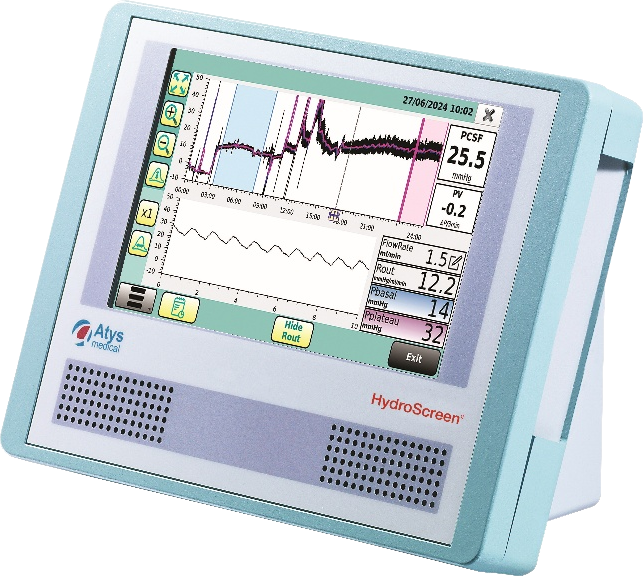

Objective Rout Measurement
CSF outflow resistance calculated from recorded pressure measurements.

Simple and Immediate
Intuitive touchscreen operation and Rout calculation at the end of the test.

No Captive Consumables
Compatible with commonly available hospital equipment.
Why measure Rout?
Idiopathic normal pressure hydrocephalus (iNPH) is a potentially treatable neurological condition, typically associated with gait disturbance, cognitive impairment and urinary symptoms.
However, diagnosis and patient selection for shunt surgery remain challenging. Symptoms may overlap with those of other neurological disorders, and brain imaging alone cannot reliably predict the response to surgery.
Measuring cerebrospinal fluid outflow resistance (Rout) provides additional physiological information to support clinical decision-making.
An elevated Rout is associated with an increased likelihood of improvement following shunt surgery.
How Rout is measured
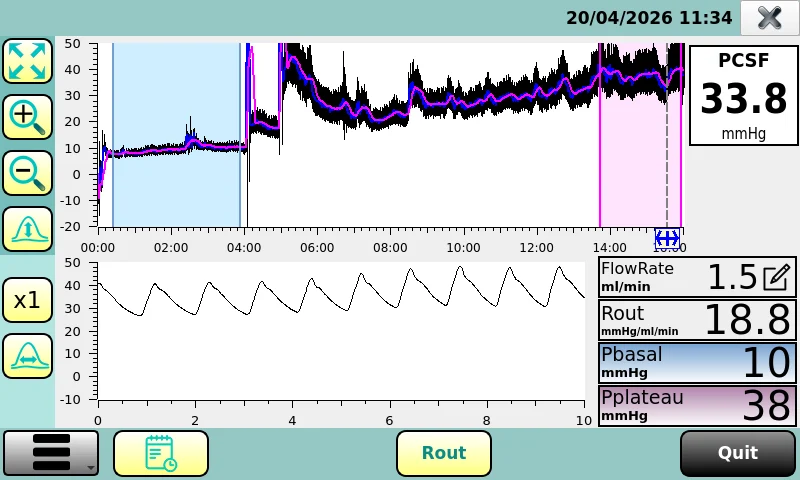
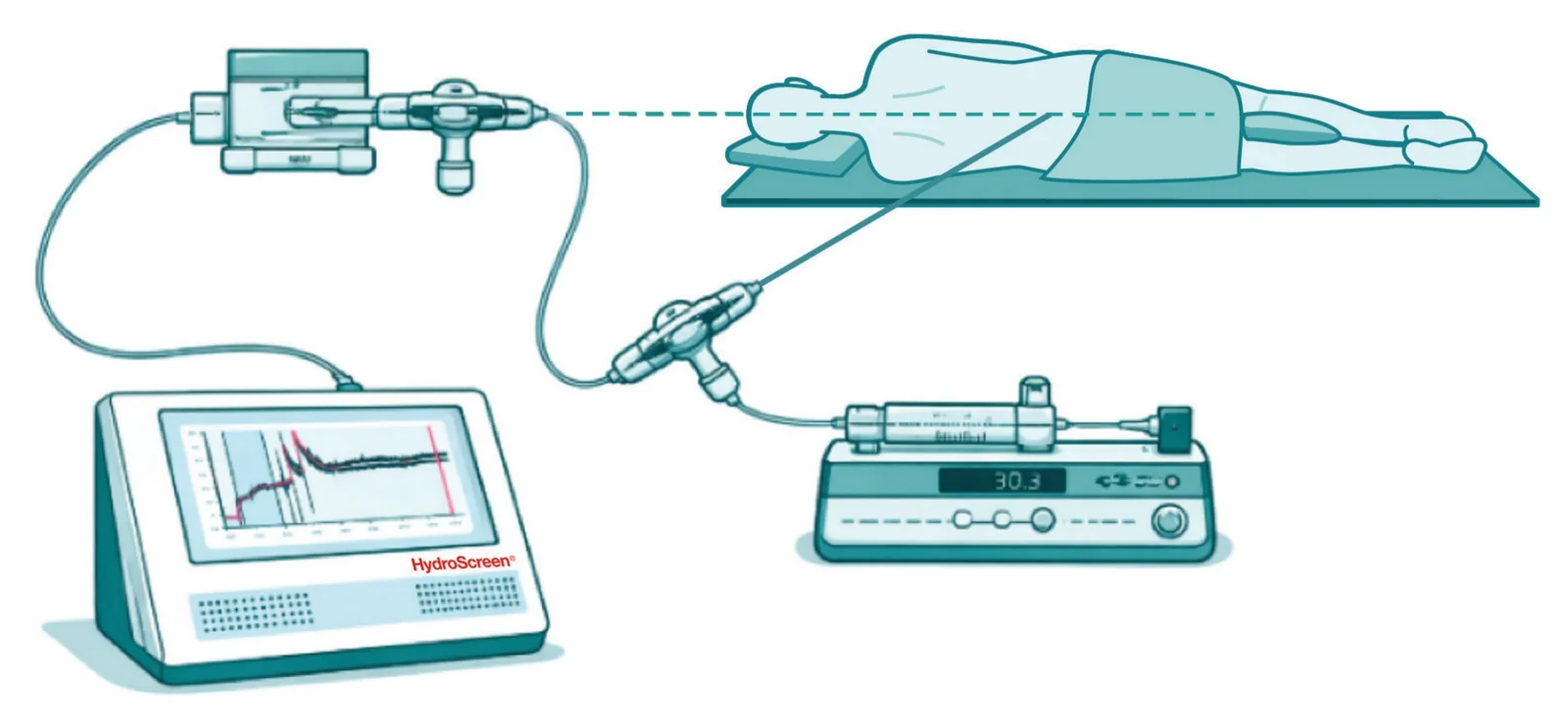
During a lumbar infusion test, fluid is infused into the lumbar subarachnoid space at a constant flow rate while cerebrospinal fluid pressure is continuously recorded.
CSF pressure increases from its basal level towards a plateau.
The resistance to CSF outflow (Rout) is determined from the difference between plateau and basal pressures, divided by the infusion flow rate.
HydroScreen® displays CSF pressure in real time and automatically calculates Rout once the measurement periods have been selected.
Rout = (Pplateau − Pbasal) / Infusion rate
in mmHg/ml/min
What the evidence shows
92%
In a 101-patient multicentre study cited in NICE guidance, 92% of patients with a Rout above 18 mmHg/ml/min improved after shunting.
Level B
The American Academy of Neurology practice guideline recommends that patients with iNPH and an elevated Rout be informed that they have an increased chance of improving after shunt surgery.
AAN guideline, Neurology 2015 [3]
- The international iNPH guidelines list the infusion test among the supplementary tests that increase the accuracy of shunt-response prediction, up to about 90%. [2]
- A negative tap test cannot exclude a patient from surgery, because its sensitivity is low. [2]
- Extended lumbar drainage requires several days in hospital, with a reported meningitis risk of 1.8–3.6%. The lumbar infusion test gives an objective Rout value in a single session. [3]
Designed for routine clinical use
No captive consumables
Works with commonly available pressure transducers, tubing and syringe pumps. Each centre keeps its own equipment and purchasing channels.

Optional procedure kit
A ready-to-use HydroScreen® kit is available to simplify preparation.

Stand-alone and mobile
No external computer or server needed. Moves easily between rooms and departments.
Immediate Rout calculation
Pressures and Rout displayed on the device, saved and exported for the patient record.

Easy data export
Examination reports and raw data can be saved and exported.
Intuitive touch screen operation
Clear interface and straightforward workflow.
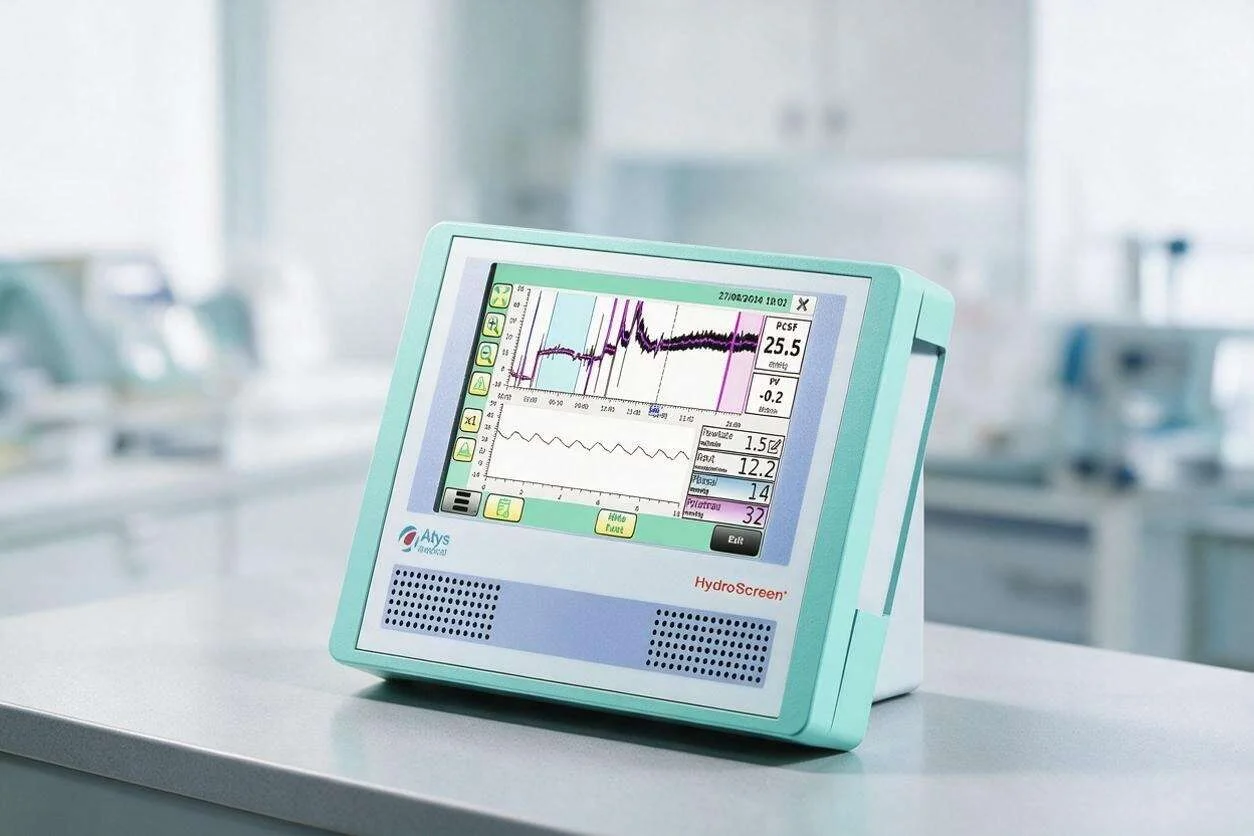
Who is HydroScreen® for?
Healthcare professionals trained in lumbar infusion testing and CSF pressure measurement, in departments involved in the investigation and management of hydrocephalus:
NeurosurgeryNeurologyGeriatricsAnaesthesiologyIntensive CarePhysical and Rehabilitation Medicine
Make Rout measurement part of your iNPH assessment
Interested in introducing lumbar infusion testing in your department?
Contact Atys Medical to learn more about HydroScreen, the available procedure kit and implementation.
Key references
- Boon AJ, Tans JT, Delwel EJ, et al. Dutch Normal-Pressure Hydrocephalus Study: prediction of outcome after shunting by resistance to outflow of cerebrospinal fluid. J Neurosurg. 1997;87(5):687–693.
- Marmarou A, Bergsneider M, Klinge P, Relkin N, Black PM. The value of supplemental prognostic tests for the preoperative assessment of idiopathic normal-pressure hydrocephalus. Neurosurgery. 2005;57(3 Suppl):S17–28.
- American Academy of Neurology (AAN) practice guideline – Halperin JJ, Kurlan R, Schwalb JM, Cusimano MD, Gronseth G, Gloss D. Idiopathic normal pressure hydrocephalus: response to shunting and predictors of response. Neurology. 2015;85(23):2063–2071.
- Manet R, et al. Managing idiopathic normal pressure hydrocephalus: need for a change of mindset. 2023.
- Jannelli G, et al. Assessment of CSF dynamics using infusion study: tips and tricks. World Neurosurg. 2024.
- National Institute for Health and Care Excellence (NICE). Lumbar infusion test for the investigation of normal pressure hydrocephalus. HealthTech guidance HTG169 (formerly IPG263). Published 25 June 2008.
Other products:


